Thursday, April 28, 2005

The News – 04/27/05

Contribute to SNS or I Will Kill My Cat!

Sound like extortion? Well it is. I’m totally serious. The cat gets it. Soon. Unless you help.

I’m inspired by a similar plea to save a rabbit named Toby. Toby’s owner and one-time savior promises to eat his pet unless the good people of the Web come up with $50,000.

Toby is the cutest little bunny on the planet. Unfortunately, he will DIE on June 30th, 2005 if you don’t help. [. . .] I am going to eat him. I am going to take Toby to a butcher to have him slaughter this cute bunny. [. . .] I don’t want to eat Toby, he is my friend, and he has always been the most loving, adorable pet. However, God as my witness, I will devour this little guy unless I receive 50,000$ USD into my account from donations or purchase of merchandise. You can help this poor, helpless bunny’s cause by making donations through my verified PayPal account by clicking on any of the Donate buttons on this site, or by purchasing merchandise at the Savetoby.com online store.

At press time, the Save Toby site claims to have received more than $20,000 in the effort to save the potential hasenpfeffer.

Toby’s plight is wringing the hearts of scads of people worldwide who are morally outraged that someone would eat a pet rabbit. (See some of Save Toby’s hate mail; warning: very rude language!) Of course, in the meantime, discarded pet bunnies are perishing in animal shelters in large numbers because they breed like, er, rabbits and aren’t quite the cuddly lap pets their owners assume they’ll be. Rabbits actually don’t like to be held and cuddled. Plus they also like to chew on electrical cords, as we found out when rabbitsitting once years ago.

Toby was not the only imperiled bunny on the Net. A rabbit known as Bernd cheated death once as his owner sought 1,000,000 Euros to keep him from the stew pot. The original deadline of December 31, 2004 passed without incident. However, the new deadline of March 27, 2005 was apparently honored and Bernd met his gustatory end. (If you want to see the site, be sure your popup blocker is in place, as there are loads of them at http://www.krohm.net/bernd.htm.) These aren’t the only two threatened bunnies. There was even a Save Fluffy site that is now defunct.

So what’s with the Lagomorphicide? A quick visit to the Urban Legend Reference Pages reveals the fact that both the Toby and the Bernd sites are jokes. The Toby site used to post an “it’s a joke” disclaimer and the Bernd site still includes one in small type at the bottom of the page. Yet the Bernd site lists dozens of donors and although PayPal has shut down the Toby account, it appears Toby’s owner has actually collected at least some of the money the site claims.

So what’s the big deal about a dead rabbit? Even the straight press (OK, perhaps MSNBC isn’t properly the straight press) has taken up the clarion cry, identifying the Toby perpetrators as two college students from the east coast. The students claim to be serious; they really will eat the rabbit. The horror!

Endangered rabbits aside, Web extortion is actually a serious business. Rather than imperiling bunnies, real Web extorters threaten Web sites with massive attacks or with revealing sensitive information if they don’t fork over the dough.

  • A Mississippi man was recently convicted of two counts of extortion — one for threatening to damage property and reputation and one for threatening to damage computers – for trying to extort $2.5 million from BestBuy by threatening to expose the security weaknesses of the company’s Web site.
  • A ring of Russian criminals tried to shake down online gambling sites for $40,000 and actually launched successful attacks that took the barely legal sites down.
  • There have been too many incidents to list where criminals stole credit card numbers from Web sites and then sought payment for not releasing or selling them.

So online extortion is a real problem, even if endangered bunnies are not. Yet it is hard for me to understand why people get so worked up by the impending death of an anonymous pet, especially when hundreds or thousands of rabbits are dying daily to make rabbit stew or just because nobody cares for them. The human heart has an infinite capacity for empathy that unfortunately appears to be matched by people’s infinite capacity to believe whatever they read or see on the Internet. Until something changes, hoaxes like the bunny problem will continue to distract people from the real problems our civilization faces.

But, seriously, my cat’s dead if you don’t fork over some cash.

P.S. I’m allergic to cats and haven’t had one since childhood.

Briefly Noted

  • Shameless Self-Promotion Dept.: It’s here: A wireless networking company called The WiMAX Guys. Our main business is new installs for people who want to set up wireless hotspots such as hotels, warehouses, apartment buildings, and office buildings or hotzones that cover cities. We also sell a knowledge-based Web portal called the MAX K-Base. Check out our main Website at http://www.thewimaxguys.com/. My wife created a bit of a stir when her op-ed piece was published in the Minneapolis StarTribune newspaper after the election. Her article, “Two Nations, Handcuffed Together,” has been commented on or linked to by more than 85 Websites. She’s now created a Website to capitalize on her newfound pundit status. Check it out at http://www.debellsworth.com/. Coming At Some Point: A new eBook, Be On the Wave Or Under It™ will collect the best of SNS’ insights over the last couple of years, along with additional material from CTOMentor white papers and new material. It will make a great gift for associates and friends in need of a guide to the latest and greatest technology. Watch for more information in upcoming SNS issues. Several issues ago I debuted SNS Begware, an opportunity for you, gentle reader, to express your appreciation by tipping your server via PayPal. See the sidebar for more info. Total in the kitty so far: $91.48. Thanks Dave!
  • The Raw File – SNS is dedicated to delivering the scoop on the latest and greatest. However, I collect lots of information that never makes it into the newsletter before it gets old. I’ve collected all this aging info into a page called The Raw File. This page is the raw information I gather for SNS articles. It’s not pretty, and some may be a little incoherent, but chances are there are still things in TRF that might be news to you. So therefore, use The Raw File at your own risk – it’s 45+ pages of the best stuff that didn’t make it into SNS. The Raw File
  • Cyborgs on the Horizon: Thanks to Alert SNS Reader David Dabbs for the pointer to a blog detailing a new kind of creepy craze: using implanted RFID chips to unlock your car and perform other authentication tasks. RFID stands for Radio Frequency Identification, which uses a tiny radio receiver to store data that is then read and used to track the movement of goods. The tags on expensive clothes or other items in stores are a form of RFID. But there are other potential uses for RFID technology, including tracking people. While many privacy proponents are concerned about the implications of implanting RFID in humans, some protocyborgs are doing it themselves. UberGeek Amal Graafstra embedded a RFID tag in his hand to easily open his car door, home and to be used as his "password" for a Windows login prompt. Graafstra hacked together a series of RFID readers that read the encrypted serial number in the chip and allow him to do an open sesame with the wave of his hand. Kind of reminds me of the Mechanists in Bruce Sterling’s great story cycle, The Schismatrix. The future is trying to be born. Makezine
  • More Exploitation and Net Begging: So you’re a twentysomething and photographers from a popular brand of casual clothing take you aside on a street, put a hoodie sweatshirt on you, snap your picture, and put it on the cover of their catalog. Sounds great, right? You’re famous. But fame can have a dark site, as Caleb found out. Warning: this link is to a video of Caleb’s plea for compensation and it contains rude language. Caleb's Plea
  • Things You Thought You Knew How to Do: I used to work for a guy who forbade us to talk about doing things the “right way.” He reasoned that there were many right ways to do things and asserting a single right way limited our thinking. Well, I thought I knew how to fold up a shirt. Turns out there is a right way. See the video. Albino Black Sheep
  • Things That Make Your Skin Crawl: Just because you’re a Neanderthal white racist doesn’t mean you’re not thinking about the future. Stormfront Futurist Thread
  • Blast From the Past: Style vs. Substance: From SNS three years ago: I recently came upon this very interesting article written in January [2002] by Jason Pontin, editor of Red Herring. It draws parallels between Carly Fiorina of HP and Jeffrey Skilling, former Enron CEO. Pontin accuses both, and most of modern technology marketers, as being empty suits, more concerned with the “message” of their company than with the company’s business. It’s an interesting read. Red Herring (registration required)

Friday, April 15, 2005

Yub-a-Nub-Dub, a Mall in the Web

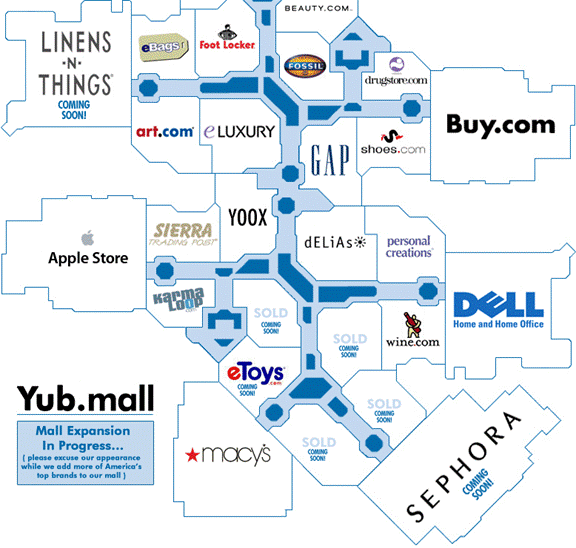
Shopping on the Web is far from new, and social networking (see a previous SNS) is becoming commonplace. But startup Yub has combined the two to create a virtual mall for people to hang out at, meet others, and do some shopping.

The concept of the virtual mall has been kind of the Holy Grail of online retail from the very beginnings of the commercial Web. Years ago when the Earth was cooling and few business people had even heard the term dotcom, I worked with a visionary by the name of Christopher Locke. Locke pioneered many now-common Internet concepts, from the mass-distributed online newsletter to the idea that people would pay for electronic stuff they could buy online.

Locke’s vision was to create a knowledge exchange on the Web, where Fortune 1000 companies could hang out their shingle in cyberspace. And the metaphor he used for MecklerWeb, his unsuccessful attempt to create this concept back in 1994, was the mall:

Think of a successful mall. Anchor stores create the foundation for dozens of smaller businesses to sell their products. Co-location of the businesses attracts customer traffic that can support the whole operation. In a well designed mall, everybody benefits: the mall management, the store owners, and the customers -- because they get a wider array of products and services. In a physical mall we can also say that the local community benefits.

Locke coined the phrase “fast cheap and out of control” to describe the MecklerWeb effort. Unfortunately, the project was way ahead of its time and was supported by an events and publishing company that didn’t have a clue. (Locke later went on to co-write the Cluetrain Manifesto, which should, even at this late date, be required reading for every company using the Web.)

We all know the rest of the story: Selling atoms on the Web (Amazon) has succeeded and now is a big business. Selling bits (iTunes) has yet to fully mature. And the mall concept, where multiple retailers congregate in a destination portal, has produced numerous flameouts.

Yub is trying to fight that history by combining a hot trend, social networking, with the anchor-store mall concept. Along the way, they also are incorporating another sales concept with a checkered past (Net Perceptions – I still have my stock): peer recommendations.

The collection of merchants in the Yub online mall is impressive: Target, Sony, iTunes, Dell, Macy’s and more. Nonetheless, having a group of retailers on the same site is so last millenium. What’s unique is that on the main mall navigation page and throughout the site are links to pictures of Yub members alongside links to the stuff they rave about. Click on the picture of the foxy lady or the hunky guy to meet the person. Click on the picture of the merchandise to check it out and buy it. Brilliant! It’s the mall hangout refined and electrified.

Yub combines this melding of two hot online trends with other, more-standard, online retailing techniques like buying clubs, electronic couponing, viral marketing, and multilevel marketing. You can join for free, but if you join YubClub for $25 a year, you get up to a 15 percent discount, plus a 1 percent kickback if people by the stuff you recommend. Brilliant!

On the social networking side, there are user forums, instant messaging, and the ability to create and customize your own page (see mine). You can also use Yub as an online photo album with 100MB of storage.

So Yub has the whole package and it’s pretty well executed. Their slogan, “Meet. Hang. Shop,” is a perfect encapsulation of the mall experience, at least for happening younger folks. Me, when I shop at a mall, especially the humongous Mall of America, I get in and get out as quickly as I can and have little interest in meeting new people at the mall. But I don’t think I’m in the target demographic.

And the name? The company says Yub is "buy spelled backwards, an apt name since we’re turning buying inside out by facilitating buying thru friends and real people. Instead of buying what the stores tell you to buy, and then becoming a consumer, we flip it, allowing you to hear what the consumers say before you buy. Yub is also an acronym for our core user—the Young Urban Buyer."

Yub also turns out to be part of the Ewok word for freedom, yub nub, and there is a flourishing Star Wars community site called Yub-Yub.Galacticbrick.com.

Yub was launched originally as Metails by three entrepreneurs from Cambridge, Massachusetts. But it took their merger with veteran online retailer Buy.com to transform the concept into Yub and put the marketing oomph behind it.

Obviously, since Yub only launched recently, the jury is still out as to how well it will succeed. But it looks to me like they’re doing everything right — from the targeting, to the marketing tools, to the mall experience. Of course Yub may turn out to be one of those magnificent Internet failures like Net Perceptions that change the whole approach of an industry (see Amazon’s “others who bought this also bought . . .” feature, a direct application of the Net Perceptions recommendation engine concept).

Yub nub and may the force be with you!

Yub.com

Briefly Noted

  • iPod in the Classroom: Alert SNS Reader Peter Ellsworth sent along a link regarding student use of iPods at my alma mater, Duke University. When I originally heard that Duke was issuing iPods to all 1,600 members of the incoming freshman class this year, I was puzzled. Duke experienced the largest number of applicants in its history this year, so why offer another incentive, especially one that not only wasn’t directly related to the university’s mission, but one that would also add immensely to the traffic on its network? Turns out that there was method in that madness. Apple and Duke figured that bright young minds would come up with new uses of the entertainment-oriented device. And they did. Computer Science students use the iPod to move large files so can take them home. Other students access lectures and course material on their iPods and take them with them on the bus or to listen to during other non-productive time. One professor split students into small groups of to discuss a topic and then submit an MP3 instead of turning in a written paper. He found the quality of the work was far superior to any of the written work he previously received. Because of success stories like these, Duke is expanding the iPod giveaway to the rest of the undergraduates next year. This is just another clue that we are rapidly turning into a post-literate society in which normal kinds of literacy (involving books and written material) are deemphasized in favor of other modalities. Simply put, that means if you or your kid is the kind of person with only a nodding acquaintance with new communications technologies, you’ll be under the wave, not on it. Playlist Magazine
  • WiMAX at 100 mph: You may have heard of the next big thing in wireless, a technology called WiMAX. It promises to be really fast and extend really far, way beyond the 300 feet or so that current Wi-Fi hotspots can manage. You may also know that the techies have been hassling over the WiMAX standard and a couple of competing standards that enable what is known as mobility, the ability to get high bandwidth while moving, even in a car. The original standard was intended for fixed use – beaming Internet connectivity to your house or office – rather than mobility. The various standards factions have sniped at one another and declared each other redundant and so on and on. Well, those who wasted energy complaining that WiMAX couldn’t do mobility should have put that energy to use, as T-Mobile has done in the UK, where they’ve enabled wireless Internet usage on 100 mph trains over a 60 mile corridor. Using pre-standard WiMAX gear (about all that’s available due to the lag in certification), T-Mobile communicates wirelessly with the fast-moving trains. Inside the trains, the connection is handed off to Wi-Fi access points that passengers connect to with their normal Wi-Fi cards. The company is offering it for free until the system is complete, but will eventually charge their normal rates. What’s cool about this is that T-Mobile realized that communicating wirelessly with a finite number of known fast moving objects on a predictable path is way easier than true mobility – the ability to keep a connection when many users are moving in random directions. Thanks to Alert SNS Reader David Dabbs for the pointer. TechWorld

Wednesday, April 06, 2005

Something New in IT Market Research – Real Data

During my 15 years in the marketing research business, I developed a healthy respect for the power of data turned into information turned into insights. I worked in Information Technology (IT) with ACNielsen from the dawn of the business PC to the flowering of online Web applications. You may know the Nielsen name from the Nielsen TV ratings folks, but I worked for the part of the company that counts how many Cheerios people buy in Minneapolis or New York or probably where you live (ACNielsen is in more than 100 countries worldwide).

ACNielsen’s information is derived primarily from the laser-scanning checkouts you’re familiar with in grocery stores, drug stores, and mass merchandisers. What is great about this type of information is that it is fact-based – a box of Tide or a six-pack of Coke is scanned at the point of purchase and forms the basis for information in huge databases that the major consumer packaged goods companies like Kraft, Gillette, and Procter & Gamble pay millions of dollars a year to access.

These companies are serious about these numbers because they represent the realities of the marketplace and are based in hard scanning data. They use this information to inform their decisions about everything from pricing and promotion to compensation for sales staffs and brand managers.

The consumer packaged goods industry is thus very sophisticated in its use of information to inform decisions and has been a pioneer in what is now called data mining. But while I worked at ACNielsen, I became very frustrated in the way that decisions were made in IT. Since the IT market research lacks a hard-data-based information source, most decisions were made by serendipitous processes. I used to joke that the way new technology came into the company was because somebody went to an IT trade show and got excited about something a vendor showed them. It was no joke, though; it was that random.

Sure, there are plenty of IT market research companies: the first rank Gartners, Forresters and the second rank Aberdeens, Yankee Groups, and Delphi Groups, and many more. But what these folks consider research I consider rumor and innuendo. The major way a typical IT market analyst gets his or her information is to call folks he or she knows in the industry and ask them what they think. (Actually, long ago there was a data-based research firm called DataQuest. The company estimated shipments of computers by stationing a spy outside the warehouses of computer manufacturers and counting the outgoing trucks! Gartner bought them in 1995.) These informants usually include the vendors of the technology, whom we can be sure are not in the least biased. Right?

Add to this less-than-rigorous data collection methodology the fact that most analysts have never used the technology they are expert in and you can see how the resulting insights can be less than accurate. In fact, go back and track the annual predictions the big research houses make at the beginning of each year and see how accurate they were, especially during the Internet bubble years. You’ll find these high-priced, so-called experts could have done better with a dart board and a magic 8-ball.

So it was a breath of fresh air when I started working with a client that is changing the rules of the IT research game.

Started by former Meta Group, Forrester Research and ACNielsen executives, Evalubase Research, Inc. is a market intelligence firm that continually gathers and analyzes the real-world experiences of IT users. Rather than presenting opinion and anecdotal evidence, Evalubase research enables IT users and decision-makers to track how IT solutions perform in the trenches among their peers.

What a great idea! Actually ask the users of a technology how it performs and what value it delivers! Evalubase’s Website (which I am responsible for developing) enables any consumer of IT technology (including you, gentle reader, who at the very least has experience with personal computers) to establish an account and within 5 to 10 minutes create a comprehensive evaluation of that technology. Hate a computer you bought? Evaluate it. Love the new Customer Relationship Management system you installed? Evaluate it. Since Evalubase’s customers include technology vendors, your voice can be heard.

The beauty part of the deal is that for just a single evaluation, you get a month’s free access to the Evalubase database in the category you evaluated. Non-subscribers only get summary level information, but if you’re planning a purchase, even that is way better than analyst innuendo.

Evalubase presents its information in two ways, via an integrated charting package and via an innovative IT Scorecard that compares an enterprise’s ratings with ratings from peers in the same industry, in the same geography, or with similar revenue or number of employees.

Evalubase is just getting started building its database of evaluations but already there are significant insights to be gleaned by its subscribers. And because I have inside information here, I can tell you there are plenty of innovations coming for its Website and methodology.

With the recent purchase of META Group by Gartner, the diversity of opinion in the IT market research industry has been reduced. There will probably be other consolidations of firms, and plenty of firms withered or died during the long post-Internet-Bust IT depression. I predict more and more IT consumers will de-emphasize the fuzzy math of analyst firms and turn to Evalubase’s empirical research for real-world advice from IT practitioners in the trenches.

Evalubase Research

Briefly Noted

  • Shameless Self-Promotion Dept.: It’s here: A wireless networking company called The WiMAX Guys. Our main business is new installs for people who want to set up wireless hotspots such as hotels, warehouses, apartment buildings, and office buildings or hotzones that cover cities. We also sell a knowledge-based Web portal called the MAX K-Base. Check out our main Website at www.TheWiMAXGuys.com. My wife created a bit of a stir when her oped piece was published in the Minneapolis StarTribune newspaper after the election. Her article, “Two Nations, Handcuffed Together,” has been commented on or linked to by more than 85 Websites. She’s now created a Website to capitalize on her newfound pundit status. Check it out at www.debellsworth.com. Coming At Some Point: A new eBook, Be On the Wave Or Under It™ will collect the best of SNS’ insights over the last couple of years, along with additional material from CTOMentor white papers and new material. It will make a great gift for associates and friends in need of a guide to the latest and greatest technology. Watch for more information in upcoming SNS issues. Several issues ago I debuted SNS Begware, an opportunity for you, gentle reader, to express your appreciation by tipping your server via PayPal. See the sidebar for more info. Total in the kitty so far: $86.48.
  • The Raw File: SNS is dedicated to delivering the scoop on the latest and greatest. However, I collect lots of information that never makes it into the newsletter before it gets old. I’ve collected all this aging info into a page called The Raw File. This page is the raw information I gather for SNS articles. It’s not pretty, and some may be a little incoherent, but chances are there are still things in TRF that might be news to you. So therefore, use The Raw File at your own risk – it’s 45+ pages of the best stuff that didn’t make it into SNS. The Raw File
  • Anti-Laser Contact Lenses: OK, the world is obviously getting weirder when we need to start to worry about errant lasers rendering us blind. But at least Air Force thinks there’s a need here. They solicited bids for a contact lens that “sits on the eye, the entire cornea and pupil are covered, so there is no chance of a reflection, or high angle incident beam, sneaking behind the LEP [Laser Eye Protection].” Thanks to Alert SNS Reader Andy Stevko for passing this along. DefenseTech.org
  • Really Mobile Wi-Fi Hotspot: You can’t get much more mobile than the Magic Bike, “a mobile WiFi (wireless Internet) hotspot that gives free Internet connectivity wherever its ridden or parked.” I don't care how much I pay (Too much, Magic Bike) I wanna drive my bike to my PC each day (Too much, Magic Bike) I want it, I want it, I want it, I want it ... (You can't have it!) Magic Bike
  • Nannycams Gone Wild: You may be familiar with the concept of the nannycam. Parents place a surveillance camera in their homes that is accessible via the Web to keep track of how their day care providers are treating their little charges. The parents get piece of mind and the nannies get, well, their privacy invaded, I guess. Like many technologies, however, nannycams have unintended consequences: Many of the cameras are unsecured and anyone on the Internet with access to Google can find them and eavesdrop. What’s worse, once the parents return to the bosom of their families, they may be unaware that all their activities are also viewable by anyone, which could lead to some X-rated possibilities if the cameras cover private areas of the home. Don’t believe this is a problem? Try Googling "inurl:view/index.shtml" or "ViewerFrame?Mode=" or "MultiCameraFrame?Mode=, or ‘"powered by webcamXP" "Pro|Broadcast"’. You’ll turn up more than 3,000 Webcams, most of which will be unsecured. Of course, most are not nannycams – I particularly like this view of a construction site, for example – but even so, one wonders if the Webcam owners realize their cams are wide open to the Internet. Aside: This reminds me of a piece I did back in 2001 about the Surveillance Camera Players, a New York City performance art troupe that enacted odd little playlets in front of public surveillance cameras. But it isn’t just Webcams that are open to the Web. The Website I Hack Stuff lists hundreds of devices that are (mostly) inadvertently open to all comers, everything from printers to unprotected DSL routers. So who’s to blame for this huge security risk? Just like the problem with unsecured Wi-Fi access points, I lay the blame on the manufacturers, who ship their devices with security disabled. Of course they do this because most people can barely program their VCRs, let alone figure out how to access a secured Internet device. The answer is much easier configuration and increased education by manufacturers. Don’t hold your breath.

Friday, December 03, 2004

The Zeroes at ZeroDegrees

The Zeroes at ZeroDegrees

There’s a new trend on the Web called social networking. Various sites such as Friendster, LinkedIn, Ryze, Huminity, and ZeroDegrees provide Web-based networking tools that enable people to find other people with similar interests. Some sites, like Friendster, end up being glorified pickup joints for horny folks. Others, like LinkedIn and ZeroDegrees, are places where business people can find opportunities.

Generally the way the business networking sites work is you join and then do searches for other people based on keywords they may have in their profiles. Some sites allow you to set up Webpages to talk about your interests, and some, like Ryze, also host discussion forums where you can virtually meet others who share your interests.

The business model for social networking sites is not very well defined at this point. Although some have adopted a paid membership model and others use advertising, the basic model appears to be to offer a free service to bring in the masses and try to get members to upgrade to a paid service that offers more functionality.

Social networking sites attempt to be viral by constantly reminding you to invite your friends and associates to join. And this is where I ran into trouble with ZeroDegrees.

When I joined LinkedIn, the site offered to upload my contacts from my Outlook address book and do two things: let me know how many of my contacts were already on the service, and let me easily send invitations to associates I thought would benefit from the service. This worked pretty well. I found a surprising number of my contacts were already on the service, and I sent out a half dozen or so invitations to people I thought might be interested, many of whom accepted and joined the service.

So when I joined ZeroDegrees and they offered to upload my contacts and help me invite contacts to join, I foolishly figured it would work the same way as LinkedIn. The process started the same way, with a little program you run that uploads your contact info. However, the whole thing went horribly wrong because of poorly designed software.

Instead of allowing me to select which contacts I invited into the network, the ZeroDegrees software sucked all the contacts from not only my main address book in Outlook, but also my backup versions as well! Then it proceeded to email every one of them with an invitation to join. I tried in vain to stop this, but it churned through more than 8,000 names in its zealous quest to spam everyone I know. Many of my contacts got multiple emails because they were on my main and backup contact lists. What a nightmare!

This all happened this past spring, and I’ve been apologizing to folks I know ever since.

I think social networking is a very useful tool in expanding your network and locating resources and advice on a wide range of topics. But people like ZeroDegrees can give the concept a bad name.

There need to be some safeguards in place for social networks, especially when you entrust them with the names of your contacts. I no longer, for example, belong to Plaxo, which helps you keep your contacts updated, because I was worried about what they may be doing with the information I stored on their service.

And then there’s the ethical question of entrusting the contact information of people you know or who you may have only casually met to a third party. What happens if the network closes down, or is sold to another company? What happens to all that information? It’s bad enough when it’s only your own privacy that’s concerned. But when it’s the privacy of people who have not consented to having their information share in the first place, it becomes a different issue.

All it would take to really put the kibosh on the social networking phenomenon would be to have one of the networks sell personal information to just one spammer.

If social networks and similar services become tainted with the stain of spam, they won’t flourish. But if they continue to provide strong tools and incentives to create online and offline communities, they’ll continue to be one of the fastest growing online phenomena.

Briefly Noted

  • Shameless Self-Promotion Dept.: It’s here: A wireless networking company called The WiMAX Guys. Our main business is new installs for people who want to set up wireless hotspots such as hotels, warehouses, apartment buildings, and office buildings. We also sell a knowledge-based Web portal called the MAX K-Base. Check out our main Website at www.TheWiMAXGuys.com. My wife created a bit of a stir when her oped piece was published in the Minneapolis StarTribune newspaper. Her article, “Two Nations, Handcuffed Together,” has been commented on or linked to by more than 85 Websites. She’s now created a Website to capitalize on her newfound pundit status. Check it out at www.debellsworth.com. Coming At Some Point: A new eBook, Be On the Wave Or Under It™ will collect the best of SNS’ insights over the last couple of years, along with additional material from CTOMentor white papers and new material. It will make a great gift for associates and friends in need of a guide to the latest and greatest technology. Watch for more information in upcoming SNS issues. Several issues ago I debuted SNS Begware, an opportunity for you, gentle reader, to express your appreciation by tipping your server via PayPal. See the sidebar for more info. Total in the kitty so far: $86.48.
  • The Raw File – In a recent SNS I commented that I had 40 pages of material waiting to get into an SNS issue. Well, upon looking it over, I decided much of it was past its freshness date. Since SNS is dedicated to delivering the scoop on the latest and greatest, this stuff no longer qualifies. However, on the off chance that there are Alert SNS Readers out there who just can’t get enough, I’ve collected all this aging info into a page called The Raw File. This page is the raw information I gather for SNS articles. It’s not pretty, and some may be a little incoherent, but chances are there are still things in TRF that might be news to you. So therefore, use The Raw File at your own risk – it’s 35+ pages of the best stuff from 2003 that didn’t make it into SNS. The Raw File
  • Speaking of Portals: I recently wrote a little ditty on a social networking site about the ill-defined concept of Web portals. Here’s an excerpt: [The portal concept is ill-defined and hard for business people to understand], but not only because portals’ “value propositions” are so technical. That’s part of it, but I think one of the bigger problems with portals as a business solution is the terrible fuzziness of the term’s definition. Many people [. . .] think of portals as a bunch of links. Others think of them as the Web front end to whatever software they’re selling. Still others see them as simply a front end to a major search capability. Like CRM, the term portal is many things to many people, or even everything to everyone. I see a Web portal primarily as a way to collect a multitude of interactive capabilities in a single UI. A business portal, on the other hand, is much more. It is a way to integrate applications and data that business people need to use every day to do their jobs. Some of the more important capabilities include the ability to author pages, to share information (file libraries, discussion groups), to control access to information, and to immediately locate relevant information (search capabilities, RSS newsfeeds.) The average business person is awash in information. Making sense and deriving context from this information is a critical need as is the ability to communicate insights gleaned from the information ocean. One of the most fascinating commentaries on the Richard Clarke 9/11 flap was from an observer who noted that there were probably a dozen or more single issue Cassandras like Clarke running around the government wailing about the clear and present danger of their pet worry: “Arrrgh! Global warming!” “Aaaah! The North Koreans!” Eiiee! Hamas!” What the Bush administration obviously failed to do was to extract the signal from that noise and realize the significance and immediacy of the Al Queda threat. The problem is obviously knowledge management: knowing not only what you know (tough in large corporations), but the context and significance of what you know. That’s why the knowledge-based portal we are developing, MAX K-Base (www.maxk-base.com), will be integrating a world class knowledge engine in its next iteration. Rather than being a fairly dry and academic exercise in taxonomies and hierarchies, knowledge management must be useful and pertinent to business users. And that’s, IMHO, where the promise of portals can help.

Thursday, February 26, 2004

Index of /w2k_greps

This was sent by a friend and if you don't like rude words, pass on by. It's a series of text files that contain comments from the Windows 2000 source code. The comments contain rude words, and one wonders if the Microsoft coders' moms are proud of them now.

Nonetheless, it's really a facinating look inside the sprawling code of a major Windows operating system. And it does give us a picture of why Windows OSes are so buggy. Even the coders know they're screwing up!

Friday, November 21, 2003

'Spyware' steps out of the shadows | CNET News.com

Here's a targeted spyware campaign that was very dangerous. The best thing I've found for finding spyware is SpyBot Search & Destroy, which has the funniest usage license ever. It claims to be "dedicated to the most wonderful girl on earth :)" Isn't that sweet?

Smaller chips built using DNA as template | CNET News.com

Computing just keeps getting smaller and smaller.

Monday, November 10, 2003

Vernier Networks

I'm doing some work for Vernier Networks and I must say I'm impressed with their comprehensive suite of wireless management and security solutions. Perhaps the most interesting capability their solution has is a virus filter, which can help keep viruses off the core network. Since promiscuous AP association can result in lots of unwittingly infected laptop users on your network, this is a really good idea.

Tuesday, November 04, 2003

Verizon Wireless and Lucent Technologies Launch Commercial 3G Mobile Data Network With Speeds That Rival Fastest Wireline Connections: "the commercial launch of a third-generation (3G) mobile data network in the Washington, D.C. area. Customers can now experience a high-speed, wide-area, secure wireless data network -- BroadbandAccess -- based on CDMA2000® 1xEV-DO technology. "

This chest beating ignores the fact that Monet Networks has had 1xEV-DO networks up in Duluth, MN, Fargo, ND and other hinterland areas for quite some time. I wrote about this in a previous SNS.

This reminds me of a claim years ago that the first multimedia multicast was done by some hot dotcom when in reality, it was done on the experimental MBONE years before -- multicasting the cult favorite movie WAX - Or the Discovery of Television Among the Bees by David Blair. I first saw the flick at 3CyberConf in Austin and was privileged to have dinner with Blair after flying in with him (via airplane, not via bees).

Accessing MSN via cell phone? It'll cost you | CNET News.com:

I guess Microsoft figures, somebody's got to make some money on cell phone networks. Might as well be us. How much will you pay today?

Sprint PCS Text Messaging Down While Carrier Migrates Network

In the best tradition of the RIAA, Sprint apparently adopts a "screw the customers" philosophy by taking down their SMS service without warning.

You Snooze, You Lose - CSO Magazine - September 2003: "In the strongest sign yet that the government will, if it must, regulate corporate security, the Federal Trade Commission is cracking down on companies with lax security on their websites."

I say it's about time! If it takes the Feds to get the average corporation interested in security, I guess that's OK.

Wherever They Go, There You Are

I wrote this article about marketing uses of SMS for the Reside newsletter.

Wi-Fi Help for High-rises

Here's Wi-Fi Planet's take on BelAir Networks. Look for The WiMAX Guys to be an early adopter of this technology.

BelAir Networks

I'm starting a new service: blogging the raw material that goes in to the making of my email newsletter, The StratVantage News Summary. These are items that may or may not make it into future issues of SNS. So you can get a jump on the wave by checking back here frequently.

BelAir networks has a revolutionary, single AP design for covering large areas of building with Wi-Fi networking.

ManyWorlds.com - The Knowledge Network for Thought Leaders on Business Strategy, Innovation and Futures.

I'm a featured Thought Leader among the distinguished company of Michael Porter, Patricia Seybold, Clayton Christensen, Clay Shirky and others in ManyWorlds' Though Leader Showcase.

Innovative Marketers Target Unwired Customers

I wrote this article on wireless SMS marketing for the NetSuds newsletter.

Enterprise Architect - Grid Computing Takes Off in the Enterprise

I wrote this article for Enterprise Architect magazine's inaugural issue in May, 2003.

Enterprise Architect - Companies Collaborate on IT Practices

I wrote this article about Project Avalanche for Enterprise Architect magazine's October, 2003 issue.

Why Your Company Needs a Professional Wireless Networka>: I wrote this article for Reside's electronic newsletter. I focuses on the need to have professional installation and commercial equipment if you want to have a business wireless network.